
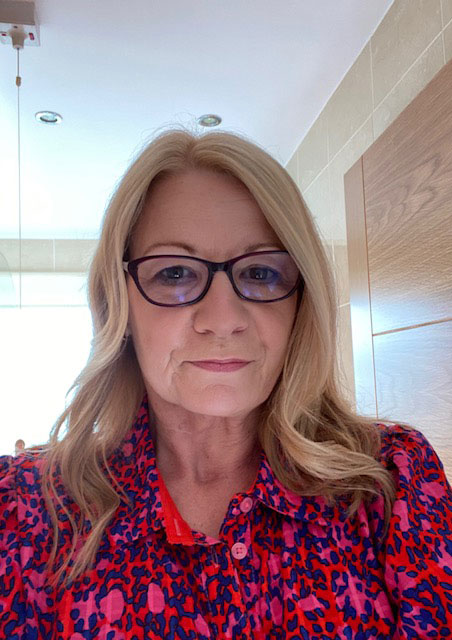
Back in 2016, I was enjoying every day at school. I loved my job as a primary school Headteacher and in my spare time, enjoyed walking, travelling and spending time with my wonderful grandchildren. I was fit, healthy and loving life.
The appointment came round quickly and the tiny sore spot remained. I asked for an immediate referral to a local private hospital, where I had a biopsy under very heavy sedation: I knew nothing about it until I woke. The results came back as background lichen planus. My dentist prescribed a steroid mouthwash, which I used as needed.
Over the next three years, the sore spot slowly expanded and became ever more painful. My dentist, who I was seeing every six months, always looked very carefully and even took photographs of the area. With hindsight, I realise we were lulled into a false sense of security by the biopsy result of background lichen planus. How I wish I had challenged that as almost three years had now passed.
By Christmas of 2018, the pain really ramped up and in early January 2019, I was referred to the Westbourne Centre under the care of Martin Evans, Consultant Maxillofacial and Craniofacial Surgeon, for a biopsy. As soon as Mr Evans examined my tongue, he prepared me for the likelihood of requiring further treatment with his colleagues at the Queen Elizabeth Hospital Birmingham (QEHB).
Within a few days I had a series of appointments at the QEHB. At each appointment, I learned a little more about the planned surgery scheduled for February 9th 2019.
In order to maintain the recommended margin, I would lose about half of my tongue. A flap from my forearm would make up the defect - to assist with eating and speaking. The donor site would be made good with skin from my abdomen. Teeth from the right side of my lower jaw would be removed and I would need a neck dissection on the right side.
The night before my surgery, I wrote letters to my loved ones, including one to my younger son for the day before his wedding. I chose my funeral songs – and a half decent photo of myself for the order of service. To die on the operating table was a much better alternative to suffering a long, lingering terminal disease.
The day of the surgery arrived and I was admitted at 07.30. I remember my surgeon coming to speak with me. My husband and elder son remained with me until I was wheeled to surgery at around 09.00. I felt calm and at peace.
Upon coming round from the anaesthetic, at around 18.00, I was immediately aware of the tracheostomy and realised, to my surprise, that I was still alive!
The days that followed were quite bleak. The tracheostomy tube caused me to cough a great deal and required frequent suction. Being unable to speak was quite frightening. I relied on a pen and paper for communication. Pain control was effective, although I did ask for the cannula in the back of my hand to be removed after a few days as I found it to be extremely painful when using the morphine pump. Soluble paracetamol and ibuprofen were administered via a nasogastric tube and this kept pain at bay. I was also fed through this tube.
Usually my consultant, or someone on the team, would visit twice a day. I especially enjoyed those visits when students were present (it's the teacher in me!).
On day eleven I was discharged. My surgeon saw me on that morning and told me I wouldn't need any further treatment as all pathology had come back clear. I can't describe the immense relief I felt. Not having to go through chemotherapy or radiotherapy was an absolute blessing.
What followed was many months of learning to eat and drink again. The daily timetable I created for speech and language exercises and physio was rigorously adhered to and became my focus. After about eight weeks, I began to drive. Having been very used to the sound of my own voice, as a teacher and headteacher, initially I found it difficult to accept my new voice and struggled to pronounce certain sounds. Scarves and long sleeves hid my physical scars well. I avoided eating with others and would make excuses not to go out. Crashing tiredness affected my desire and ability to walk very far and complete simple tasks. Even having a shower and washing my hair was difficult, as movement in my right shoulder was restricted due to the neck dissection. My left arm was the graft donor site and very painful in certain positions. My old self was lost and would never return – or so I thought.
My visits to the QEHB continued on a regular basis until February 2024. It was then I received the ‘all clear' and could finally thank my surgeon for saving my life. I've had five years' extra time. I don't know what the future holds - nobody does - but I do know I will be forever indebted to Sat Parmar and the Maxillofacial team at QEHB.