
I started to get nose bleeds - nothing major just every now and again, but put it down to using lateral flow tests and perhaps damaging the nasal passage. Nevertheless, I made a telephone appointment with my GP who prescribed antibiotic cream and to see if that improved things.
Fast forward a few months and there was still no improvement (in fact it was getting worse). I was under ENT at my local hospital for monitoring of abnormal cells on my vocal chords a few years earlier, so my GP told me that when I had my next follow-up to ask them to look inside my nose.
In May 2021, the consultant said there was some damage and irritation in my nose and prescribed more ointment and a follow-up in four weeks. I went back four or five times over the next six months and eventually had some cauterisation. I was in quite a lot of pain too and felt my nose was swollen.
In March 2022, I was referred for a CT scan - this showed nothing unusual and the consultant was "perplexed" (his words were "I don't think you have a tumour as your nose would have collapsed by now!") so decided to refer me to a specialist rhinologist (or nose doctor as he called him) at Guy's Hospital in London.
I saw Dr Ben, the consultant's registrar, on 19th April 2022. He examined my nose and said they needed to take a biopsy - something that I was expecting. By this time the end of my nose had become lumpy and hard and quite painful. When I blew my nose there was always blood. The biopsy was taken under general anaesthetic on 27th April. It was a short procedure and I felt okay afterwards, but still had pain and swelling. Dr Ben called me at 5pm on the Bank Holiday Monday the following week and asked me to come in the next day at 10am. I probably should have known something was not right, but he sounded fairly upbeat.
I went up to Guys with my partner, Chris, and when I was called into the consulting room there was a nurse there too - I noticed her badge was and she was an oncology nurse so I kind of knew what they were going to say.
After a few minutes explaining the history, he told me that the biopsy had shown that I had a cancerous tumour in the nose. He said that it was stage 1/2 and options would be either surgery or radiotherapy. I needed to have another scan that day and a number of other tests which he would arrange. I also would see an oncologist urgently. I asked if in his opinion it was treatable and he said yes and to be honest as much as you don't want to hear the word cancer it gave me an answer and I now knew that there was a plan to fix it.
Before the CT scan, the nurse, Hannah, took us into another room to just go through any questions we had. My initial thought was how to tell my children; their grandad had passed away from cancer two years previously and had been under Guy's, so I worried that they would think this would happen to me. She gave me a Macmillan book about Head and Neck Cancer, something I had never heard of before and I was sent off for my scan. I was also given an oncology appointment for the following Friday.
We went home and I told friends and family, but I made sure the children knew first, my son was in his 2nd year at Swansea University, so I had to tell him over the phone, and I told my daughter, who was 17, when she came back from school. They seemed okay about it, as I remained positive and told them that it was treatable. We do what we have to do.
On 13th May, I had my oncology appointment with Mr Reiss-Ferreira. I took my sister-in-law with me. We sat down and he told me that the team had reviewed my case and the scans had shown a squamous cell carcinoma in my nose, they had decided it was a stage 4 tumour and although there was no sign of spread, it was breaching the skin (the lumpy bit making me look like a big like a triceratops) so that was why the stage was so high. It was very rare and very aggressive. At that point I remember just asking lots of questions and feeling overwhelmed with all the information so I asked him to write it down (I still have this piece of paper with illustrations and numbers which included percentage rates of success for the different treatments).
Treatment options were explained to me and it was a choice of surgery (a rhinectomy - removal of some of my nose) or radical radiotherapy and chemotherapy - the latter option was the preferred and statistically had a better chance - he wanted to "blast it"!
He explained that I would have daily radiotherapy for six weeks and chemotherapy weekly (describing the treatment as a cake - chemotherapy was the extra sprinkles and if I did not tolerate it he would stop it). I remember thinking that's not too bad I can do six weeks! But even though he went through the side effects I don't really think I appreciated what was to come.
More appointments with dentists and dieticians as well as full renal function test and a needle aspiration of my lymph nodes via an ultrasound scan to check if there was any sign of spread. I was told my treatment was planned to start two weeks later on 30th May.
I came home on the train and remember just bursting into tears when Chris picked me up - how was I going to put that mask on every day for six weeks!?
I was given my appointment schedule, which in itself was overwhelming. Friends and family knew I had some anxiety about travelling on trains so all offered to come with me - I basically just added names to dates for the first 2-3 weeks so felt a bit better about it. Throughout this time I tried to remain positive and listened to all the advice given to me, but I didn't Google anything I wanted to trust the team of people looking after me.
I was obviously terrified and anxious about the treatment, the success was only 40-60% and I may still need surgery but I was determined to do what I needed to do in order to give myself the best chance.
On May 30th 2022 I had my first chemo and radiotherapy. I was to have a two-hour infusion with fluids before and after so would be there for around five hours and then go to radiotherapy. Guy's Hospital have a dedicated cancer centre where everything happens, and although it is a clinical environment care is taken to make the experience much more tolerable and everyone there was wonderfully caring and kind.
My first radiotherapy was okay - I managed with the mask and the staff explained what would happen. My nose would be packed with jelonet (a paraffin dressing) and I would have mouthpiece to breathe through, a bit like a snorkel. The mask would then be put on and clipped to the bed, meaning I would not be able to move until it was undone. I remember music being played whilst the scans and treatment were taking place, the first song being "Eye of the Tiger"! I struggled over the next few days with how the mask felt when it was put on, and I asked the staff to talk to me through the intercom at regular intervals to reassure me that they were still there - the treatment itself only took 10 minutes, but this felt like an age!
I tolerated the chemo fairly well and didn't get many side effects which was good, however the type of chemotherapy was changed half way through as I started to get tinnitus, which was something I was warned about and knew it meant it would need to be changed; this also meant that unfortunately it could be permanent and I still suffer from it now - most of the time it does not bother me, but occasionally at night it can disrupt my sleep.
Another part of my care plan was that I saw a nurse and dietician weekly on a Wednesday and had a half-way, and end of treatment review with the consultant. This was my opportunity to discuss side effects and other things, as well as having my weight monitored.
At week five I arrived for my weekly chemo, and as the usual pre-treatment checks were being done, my temperature showed as 38.5 degrees, plus an elevated heart rate - I felt okay though; I was put into a side room and a number of tests were done as they suspected some kind of infection, but they wanted a definite diagnosis before starting my chemo. It was confirmed as Covid-19 a couple of hours later. This meant my chemo would not be given that day, and I would have to wait until the end of the day to have my radiotherapy so to avoid other vulnerable patients. I was in a separate room and given two hours of fluids as my sodium was low. I ended up being there for nearly 12 hours but at least I got the radiotherapy treatment.
Fortunately, I did not suffer from any bad Covid symptoms, however the side effects of treatment were bad enough. Having Covid meant that my radiotherapy had to be last in the day for the final two weeks - this was kind of better for me in the end as I was beginning to feel very fatigued and my skin was really sore on my face. I was given lifts to and from the hospital from Chris and other family members so this helped.
On 8th July my treatment ended, but this was just the beginning of the side effects I was warned about - I was told they would get worse over the next couple of weeks and they did - sore and dry mouth, dry eyes and sore skin - I had also lost all of my hair underneath, where the radiotherapy had exited. The tiredness also had set in and I stayed in bed for two days - we had a heatwave around that time so it was difficult to do much else.
Over the course of the next six to eight weeks I began to feel better, my skin cleared up fairly quickly and I felt less tired. The dry mouth and lack of taste and smell was the main thing to contend with, and with my nose constantly blocked, sleeping was challenging as breathing through my mouth compounded the dryness.
At the end of September I had a PET scan at St Thomas' Hospital and was called to see Dr Ben in ENT on 8th October - the scan showed a small amount of what they thought was the remains of the tumour and they wanted to do surgery to remove it - but they were confident that the treatment had worked.
I had the surgery on 12th October where they removed 2.5mm of tissue and the remaining tumour - this also meant that some of my septum was removed too - Mr Surda, the consultant rhinologist told me that they would normally remove more healthy tissue, but had to balance it otherwise my nose would be completely collapsed, but they were again confident that they had got it all and treatment was successful.
After seeing the oncologist again at the end of November, I was told that I would be monitored very closely over the next year, having scans every 4-6 months and alternated between ENT and oncology appointments - as my cancer was very rare, aggressive and difficult to access they wanted to keep an eye on things - something I was more than happy with.
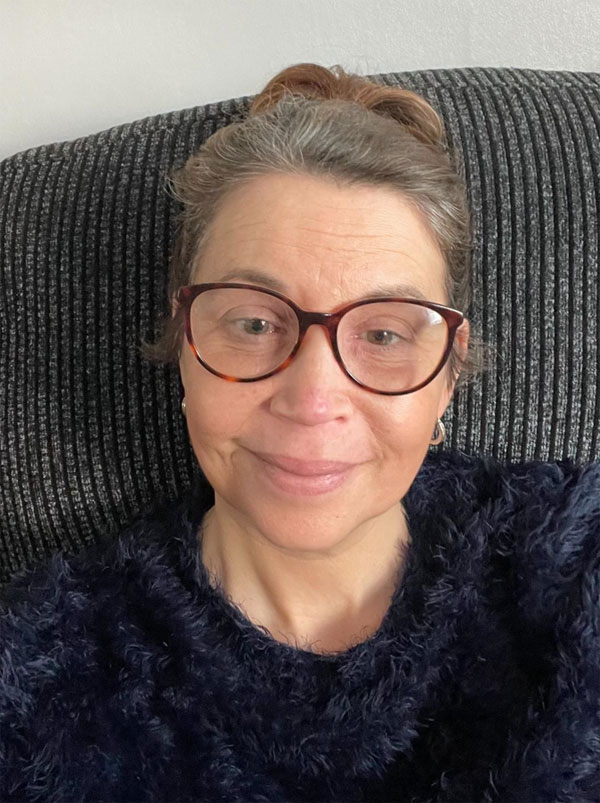
I am now coming up to a year post diagnosis and am feeling well - I still am navigating the side effects of dry eyes and mouth but this is improving slowly and I can eat and drink most things. I physically look slightly different, as my nose is flatter and smaller. This sometimes affects me as I worry that people may think something doesn't look quite right, so feel I need to explain, particularly to people I have not seen in a while; although I am always fairly mindful that things could have been a lot worse. My ENT team have said I can always have reconstruction if I want it (or need it to improve the functionality of my nose) - we joke that I can "pick a new nose".
I have returned to work and am very lucky to have the support of my colleagues in working flexibly as well as started things like yoga and Pilates to help keep active and maintain my mental wellbeing.
Part of my post-treatment care was community follow up, which included a new service where patients are offered 10-12 sessions with a psychologist- something that I fully support and am benefiting from - it is a really positive way of being able to process and come to terms with everything that has happened in a safe and non-judgemental environment.
I am now at the stage where I am wanting to know more about my diagnosis, which is how I came across the HANCUK charity website - it made me realise how little is known about head and neck cancers, which prompted me to get in touch and offer my story. I have also been accepted as a community buddy with Macmillan cancer support charity so I can provide support to others along the cancer journey.
If sharing this helps even one person to understand and feel positive, then I feel grateful to be able to do so.